|
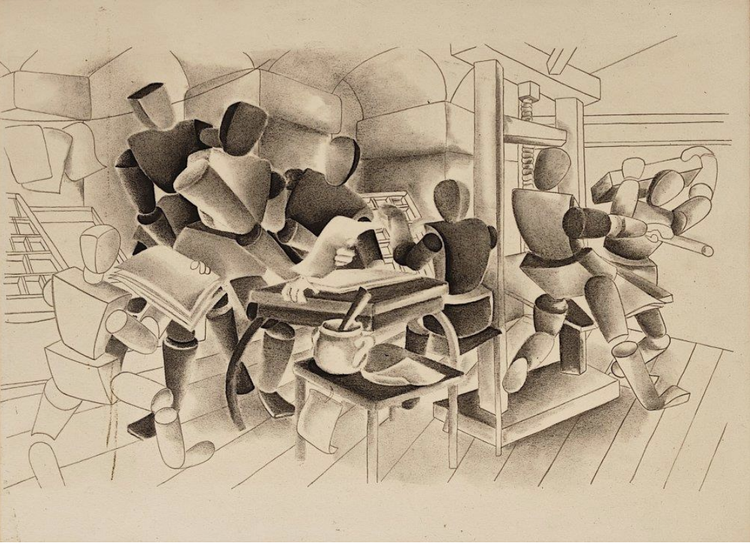
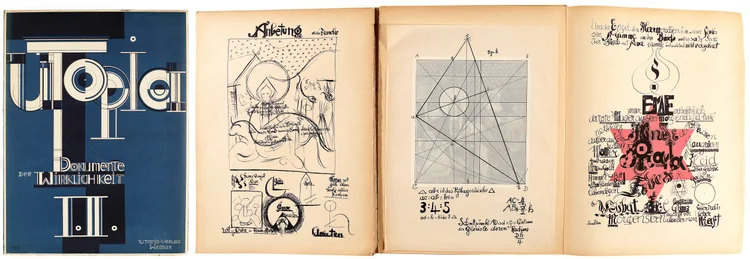
In this fantasy image, seven articulated mannequins are pictured in a print shop delivering paper, inspecting it, arranging the chase, and delivering it to the press. Like a motion study photograph by Eadweard Muybridge, these jointed figures (such artists’ mannequins are known as “laymen” or “lay figures”) pictured in close proximity to one another offer a demonstration of the stages in the rapid-fire, commercial printmaking process in which the workers’ tasks are as mechanized as their machinery they feed. Little is known of the context of this drawing, which evokes the Dada and Surrealist interest in De Chirico and the mannequin as an emblem for the mechanized, post-humanist condition. The artist, Friedl Dicker (born Friederike Dicker, from 1936 Dicker-Brandeis; Austrian, 1898–1944), sometimes depicted mannequins in conventional studies of the human figure in the 1920s, but we are not aware of other drawings in which she imagines mannequins in a comparable fantasy scene. Dicker was one of a group of Austrian students, who accompanied Johannes Itten to the Weimar Bauhaus in 1919 and remained there until his departure in 1923. She is credited with the typesetting and printing of Itten’s schematic analyses of old master paintings in the sumptuous book Utopia, printed in 1921 (pictured below). In 1923, Dicker and fellow Bauhaus student Franz Singer contributed sets and costumes to Ernst Josef Aufricht’s and Berthold Viertel’s Berlin-based theater group Die Truppe (The Troop; see poster also below). Perhaps Dicker’s greatest legacy, however, is as a teacher of children at Theresienstadt (the drawings have survived at the Jewish Museum in Prague), prior to her tragic death at age forty-six at Auschwitz in 1944. Our untitled drawing derives from the collection of Edith Kramer (1916–2014). According to Bauhaus scholar Elizabeth Otto: Dicker's student Edith Kramer, who had worked alongside her with refugee children in Vienna and Prague, later called [Dicker] "the 'grandmother' of art therapy." Kramer immigrated to the United States of America and herself became one of the founders of the art therapy movement there, a type of art practice that few associate with the Bauhaus. Dicker brought Bauhaus methods into a concentration camp and used them to make the lives of more than six hundred children more bearable. Kramer would later write of Dicker-Brandeis that, "there are many forms of survival"; that her art and pedagogy contributed to the founding of art therapy suggests one such form. (Elizabeth Otto and Patrick Rössler, Bauhaus Women: A Global Perspective. London: Herbert Press, 2019, p. 16)
|