|
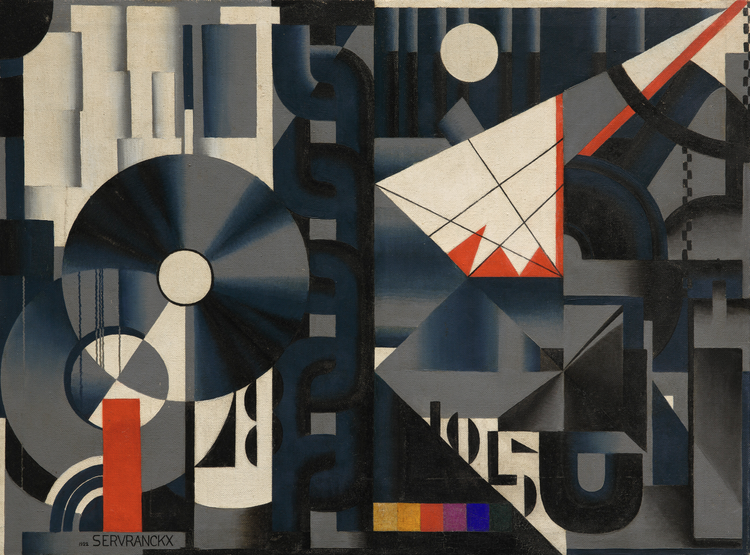
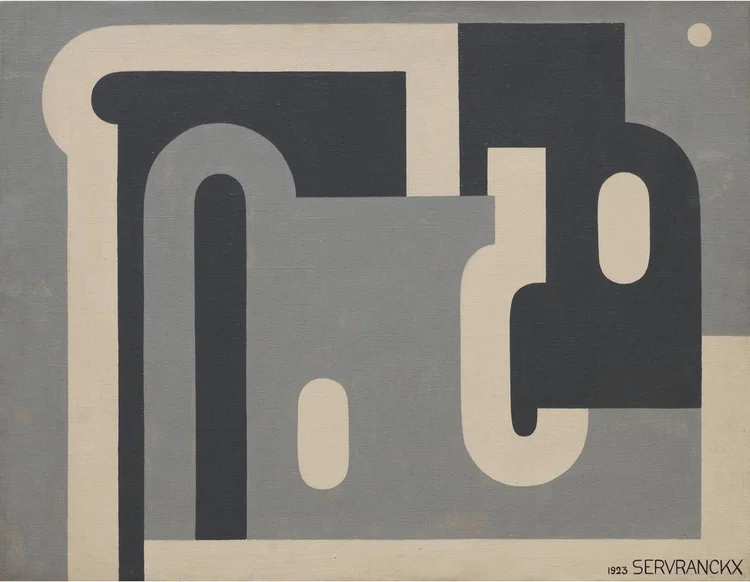
Victor Servranckx (1897–1965) was among the earliest proponents of abstraction in Belgium. He belonged to a group of artists including Karel Maes and Jozef Peeters that gathered around the Flemish-language journal Het Overzicht (The Overview; 1921–1925). Edited in Antwerp by Fernand Berckelaers (whose poems appeared under the pseudonym Michel Seuphor), Het Overzicht looked toward Russian Constructivism (via De Stijl), advocating a left-leaning ideal of universal form. “The discoveries made by Cubist painters are significant,” wrote Servranckx in 1922. “Wishing to respect the properties of the canvas, the flat two-dimensional surface, they have rediscovered the unchanging laws of painting.” “A picture is a constructed object. It should be well constructed… [ours is a] mentality that is not satisfied with an approximation, that likes a circle to be drawn with a compass, that uses the most economic means to obtain maximum effect.” Servranckx co-authored these words with René Magritte, with whom he had attended the Académie Royale des Beaux-Arts in Brussels prior to 1917. Between November 1921 and November 1922 Servranckx and Magritte worked together at the Peters-Lacroix wallpaper factory in Brussels-Diegem—the presumed “subject” of the painting above. By the mid-1920s, both artists oriented themselves toward Paris. Remaining true to abstraction, Servranckx gravitated toward Purist circles, exhibiting at Léonce Rosenberg's L'Effort Moderne and appearing on the pages of Le Corbusier’s L’Esprit nouveau. Magritte, by contrast, opted for figuration and the Surrealist orbit of André Breton. For more on abstract art in Belgium, click here.
|