|
$$PLAIN_TEXT_PREVIEW$$
Karl Hubbuch (German, 1891–1979)
|
|
Drei Modelle (Three Models), 1926–28
Watercolor on paper, 18 x 20 (45.5 x 51 cm)
|
|
In 1925, Karl Hubbuch’s work was recognized as belonging to a new, sober, realist tendency in postwar German art. That year, one of his oil paintings was included in Gustav Hartlaub’s landmark Neue Sachlichkeit (New Objectivity) exhibition, and one of his drawings was reproduced in Franz Roh’s book Nach Expressionismus (After Expressionism). The “verist,” Hartlaub wrote, “tears the objective from the world of contemporary facts and projects current experience in its tempo and fevered temperature.” Hubbuch (German, 1891–1979) was from the southwestern German city of Karlsruhe, where his art school classmates included Rudolf Schlichter (1890–1955) and Georg Scholz (1890–1945). Although Hubbuch spent most of his professional career in Karlsruhe, the time he spent in Berlin between 1922 and 1924 was decisive. There, he met George Grosz (1893–1959) and, while Hubbuch never employed the techniques of collage or photomontage (he preferred drawing and printmaking), Berlin Dada’s pictorial strategies of simultaneity, distraction, and fragmentation, together with its biting social critique, permeated his work.
|
|
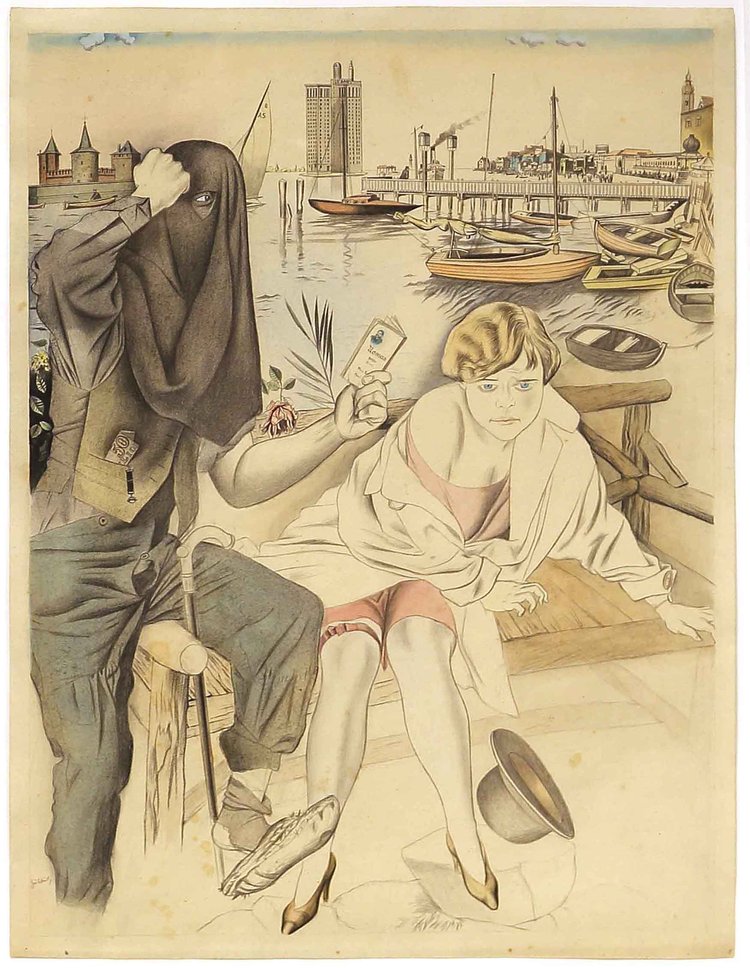
Leichter Krimi (Detective Story or Romantic Thriller), 1924
Watercolor and graphite on paper, 21 3/8 x 16 1/2” (54.1 x 41.6 cm)
|
|
Den Frommen Brauern, den Pfaffen und den Gendarmen
(Pious Peasants, Priests, and Policemen), 1923
Watercolor, pencil, and ink on paper, 12 5/8 x 12” (32 x 30.5 cm)
|
|
Jannowitzbrücke Berlin (Jannowitz Bridge), Berlin, 1922.
Third state from Die Schaffenden: Eine Zeitschrift in Mappenform
(The Creators: A Periodical in Portfolio Form), Paul Westheim, ed., vol. 5, no. 2 (Weimar: Gistav Kiepenheuer Verlag, 1926).
Etching, 12 1/4 x 16” (31 x 41cm), sheet
[Riester 1969, no. 63]
|
|
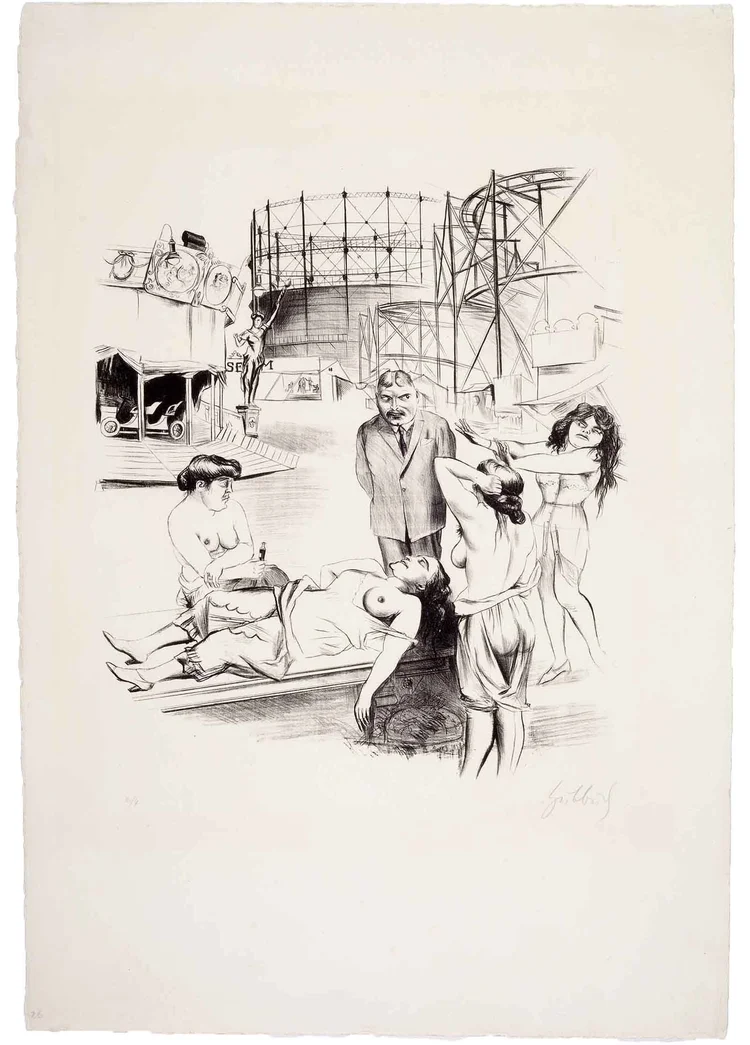
Die Giftaffäre or Das Giftfläschchen
(The Poisoning or The Poison Bottles), c. 1923
Lithograph, 21 1/2 x 14 3/4” (54.6 x 37.4 cm), sheet
[Riester 1969, no. 15]
|
|
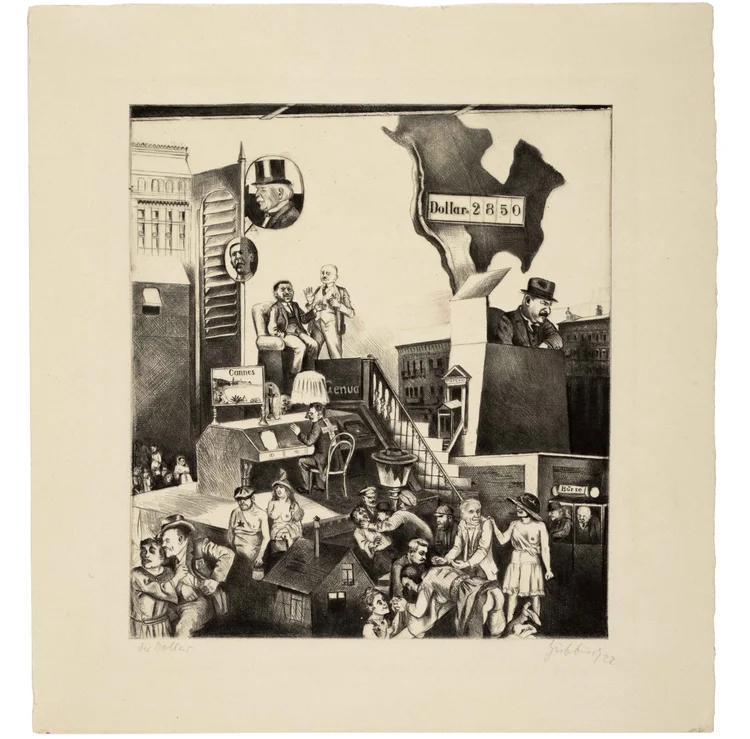
Der Dollar (The Dollar), c. 1923
Drypoint, 12 x 11 1/4” (30.5 x 28.5 cm), sheet
[Riester 1969, no. 84]
|
|
Die Mörderzentrale (Murder Central), c. 1922–24
Drypoint, 8 3/8 x 7 1/2” (21.3 x 19 cm), sheet
[Riester 1969, no. 83]
|
|
Im Rausch des Irrens (Intoxication of Lunatics), c. 1922–23
Lithograph, 22 3/4 x 29” (57.7 x 73.4 cm), sheet
[Riester 1969, no. 67]
|
|
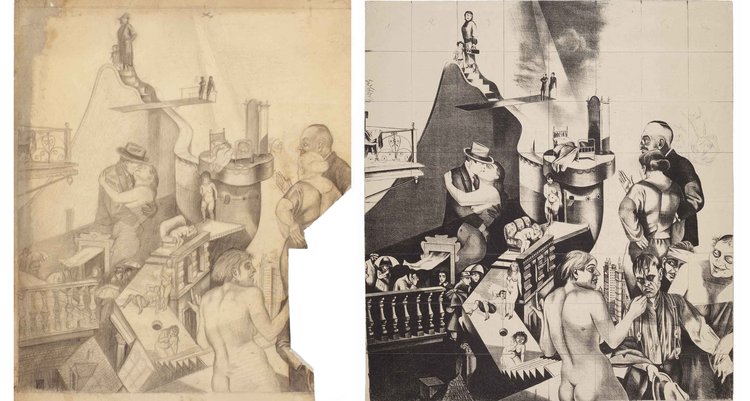
Notausgänge der Ehe (Emergency Exits of Marriage), 1923
Left: drawing, pencil on paper, 14 7/8 x 12 1/2" (37.7 x 31.7 cm), irreg.
Right: print, lithograph, 15 3/8 x 14 3/16" (39 x 36 cm) [Riester 1969, no. 69]
|
|
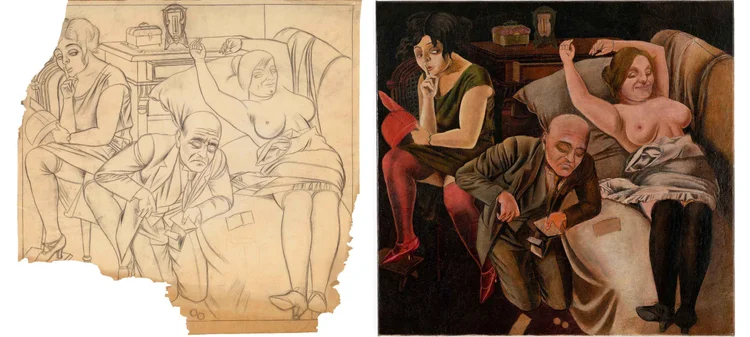
Nicht mal für eene langts (It’s not even enough for one), 1924–1925
Left: drawing, pencil and black chalk on transparent paper,
28 x 29 1/2” (71.5 x 75 cm), irreg.
Right: painting, oil on board, mounted on wood, 29 x 24 1/2” (73 x 62 cm)
|
|
Note: In addition to this pencil drawing, a watercolor and an ink drawing of this composition are documented. The painting suffered considerable water damage and has undergone extensive restoration.
|
|
|
|