|
Following in the tradition of Paris’s Chat Noir (founded in 1881) and Munich’s Elf Scharfrichter (founded in 1901), the legendary cabarets Die Hölle (Hell) and Die
Fledermaus (The Bat) were founded in Vienna within a year of each other and
within walking distance of one another. There was a continuous exchange of
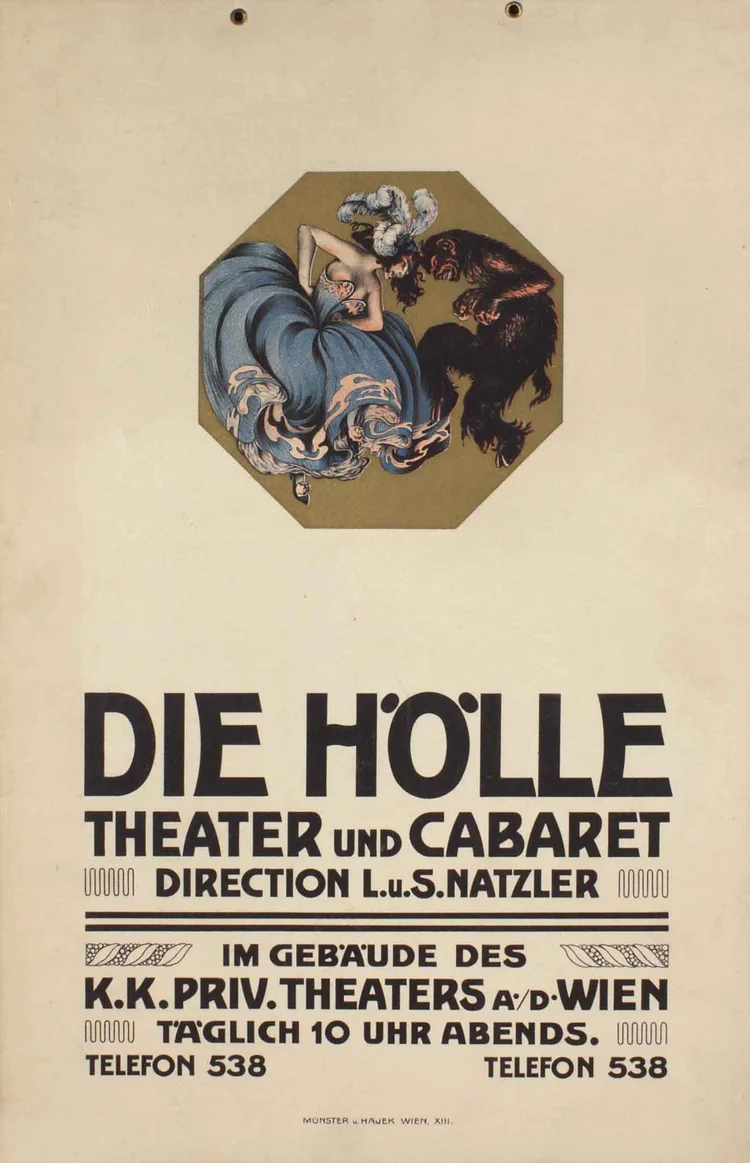
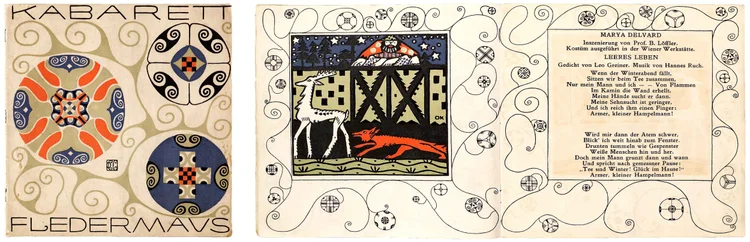
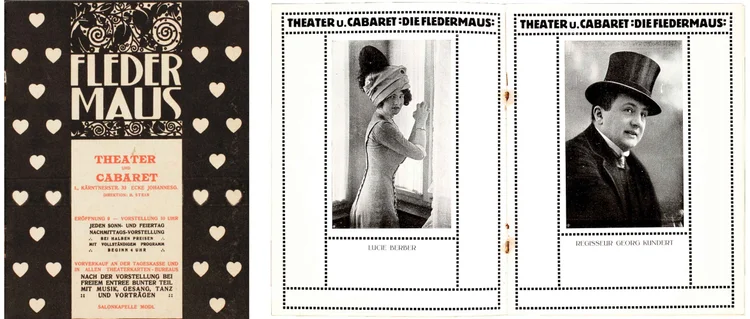
performers between the two establishments. The brothers, actors, and theater entrepreneurs Leopold Natzler (1860–1926) and Sigmund Natzler (1862–1913) opened Die Hölle in the cellar of the Theater an der Wien near the Naschmarkt in the Fall of 1906. Heinrich Lefler (1863-1919) and Joseph Urban (1872–1933), co-founders of the Hagenbund artists’ association, designed Die Hölle theater’s interior. An image by Lefler, depicting a woman and a satyr dancing head-to-head (see below) became the cabaret’s emblem. Die Hölle existed until 1928. Brainchild of the Wienier Werkstätte, Die Fledermaus represented a fulfillment of the group’s ambition to create a public, functioning Gestamkunstwerk (total work of art). The cabaret was established in the cellar of an apartment complex on the corner of Kärntner Strasse and Johannesgasse. Josef Hoffmann (1870–1956) determined the overall concept, the architectural program, many of its interior features and furnishings, as well as graphic works such as poster and program design. Hoffmann commissioned Michael Powolny (1871–1954) and Bertold Löffler (1874–1960), co-founders of the Wiener Keramik workshop, to create over seven-thousand multicolored tiles for the cabaret’s bar. Die Fledermaus operated until 1913. Select graphic materials related to both cabarets are presented here.
|