|
$$PLAIN_TEXT_PREVIEW$$
Boris Aronson’s Work for the Yiddish Theater in New York
|
|
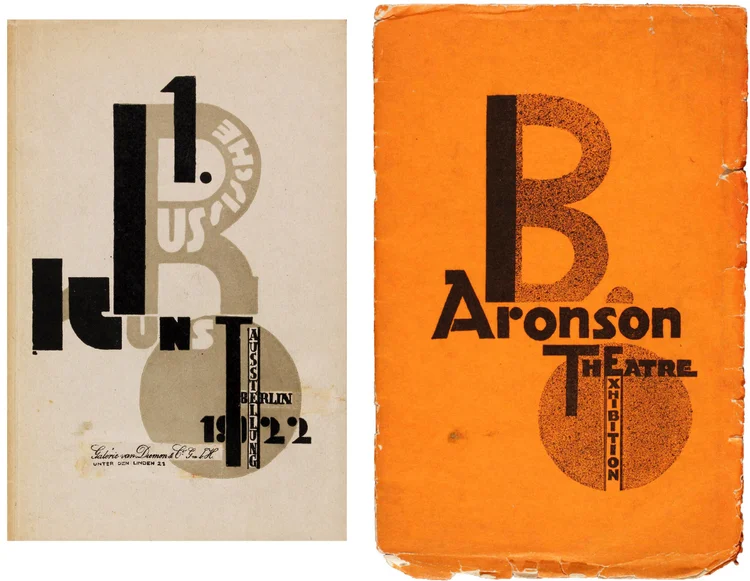
Left: El Lissitzky, Erste Russische Kunstausstellung (First Russian Art Exhibition). Exhibition catalogue. Galerie von Diemen, Berlin (October 15–December 1922), 1922. Letterpress on paper, 8 7/8 x 5 3/4” (22.5 x 14.6 cm)
Right: Boris Aronson, Theater Exhibition / Art in the Theatre: An Exhibition. Exhibition catalogue. Anderson Galleries, New York (December 13–23, 1927), 1927. Letterpress on paper, 9 5/8 x 6 1/8” (24.4 x 15.5 cm)
|
|
For Boris Aronson (American, born in Russian Empire. 1898–1980), 1918 was decisive. It was the year that he began studying under the pioneering Constructivist stage designer Alexandra Exter and that he became a founding member of the arts section of the Kultur-Lige (Culture League) in Kyiv (Kiev), an organization that sought to align the innovations of the European avant-garde with Yiddish culture. Aronson immigrated to New York in 1923, where he became active in the Yiddish Theater. His success in this area was marked by a monographic exhibition of his theater work held at the Anderson Galleries in 1927. Aronson’s cover for the exhibition catalogue (above right), deliberately recalled El Lissitzky’s catalogue cover for the landmark First Russian Art Exhibition held
in Berlin in 1922 (above left), functioning as an homage to the Constructivist
tenets that Aronson had introduced to the American stage since his arrival. Aronson’s drawings for a selection of American-period, Yiddish productions appear below. Alla Rosenfeld, Ph.D., our Research Consultant for Russian and Eastern European Collection, will present full considerations of these productions, and of Russian theater-related materials more broadly, in forthcoming collection publications.
|
|
David Pinski, The Final Balance: A Tragicomedy in Four Acts. Unser Theater, The Bronx, 1925
|
|
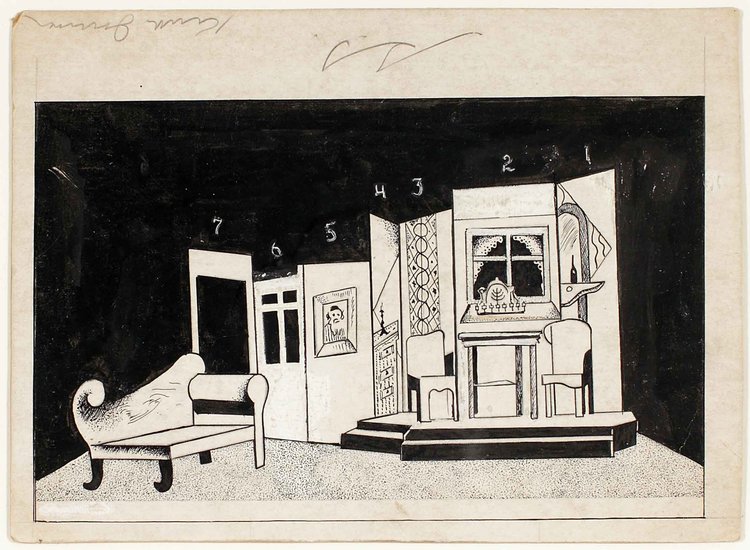
Stage design for The Final Balance, 1925
India ink on cardboard, 5 1/4 x 7 1/4” (13.3 x 18.4 cm)
|
|
Stage design for The Final Balance, 1925
India ink on cardboard, 5 1/4 x 7 1/4” (13.3 x 18.4 cm)
|
|
Abraham Goldfadden, The Tenth Commandment: An Old Play in Sixteen Scenes. Directed by Maurice Schwartz; choreography by Michel Fokine. Yiddish Art Theatre, New York, 1926
|
|
Stage design for The Tenth Commandment (Act 1, Scene 2) exterior of The Little
House in the Woods), 1926
Gouache on paper, 15 3/4 x 28” (40 x 71.1 cm)
|
|
Stage design for The Tenth Commandment (Act 1, Scene 2: interior of The Little
House in the Woods), 1926
Gouache on paper, 20 3/4 x 25 3/4” (52.7 x 65.4 cm)
|
|
Costume designs for The Tenth Commandment, 1926:
Left: A Hypocrite, Gouache on paper, 21 1/4 x 14” (54 x 35.6 cm)
Right: Joseph Buloff, Gouache and pencil on paper, 27 x 19” (68.6 x 48.2 cm)
Below: Two Jews: Chorus, Gouache with collage on cardboard, 17 3/4 x 12 3/4” (45 x 32.4 cm)
|
|
Moyshe Nadir, Tragedy of Nothing: A Play in Three Acts and Five Scenes. Directed by Miriam Eliass and Boris Aronson. Irving Place Theatre, New York, 1927
|
|
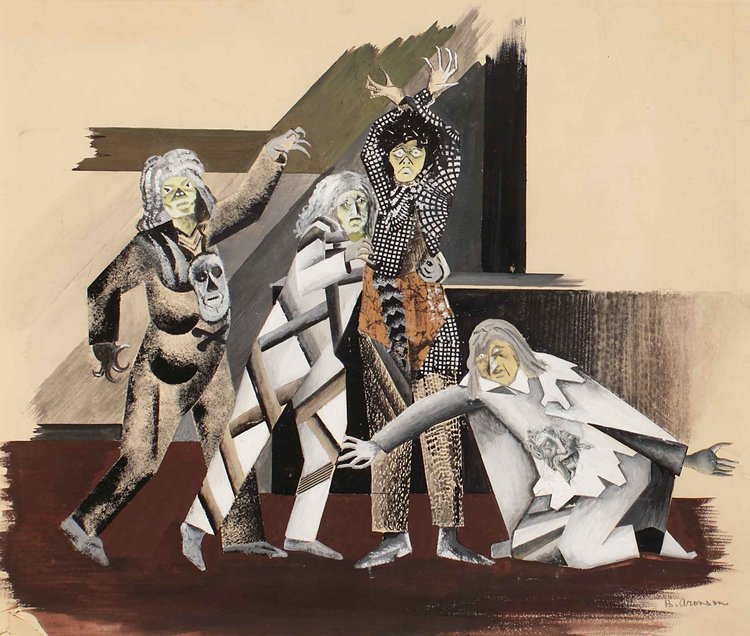
Costume designs for The Tragedy of Nothing: The Ghosts, 1927
Gouache with collage on paper, 17 x 20 1/4” (43.2 x 51.4 cm)
|
|
Unidentified production, n.d.
|
|
Five designs for costume for an unidentified production at the Jewish theater, n.d.
Each: India ink on cardboard, 4 1/2 x 2” (11.4 x 5 cm), approx.
|
|
H. Leivick, The Golem. Unrealized production planned for the Yiddish Art
Theatre, New York, c. 1928
|
|
Stage design for an unrealized production of The Golem, c. 1928
Gouache and pencil on paper, 14 1/8 x 22 3/8” (36 x 56 cm)
|
|
Beyond theater: Der Hammer, 1926
|
|
Left: Design for the cover of the Communist monthly magazine Der Hammer, 1926. Collage and ink on card, 20 x 14 7/8” (50.7 x 37.7 cm)
Right: Der Hammer, no. 2, 1926. Lithograph on paper, 10 3/4 x 8 1/8” (27.3 x 20.6 cm)
|
|
|
|