|
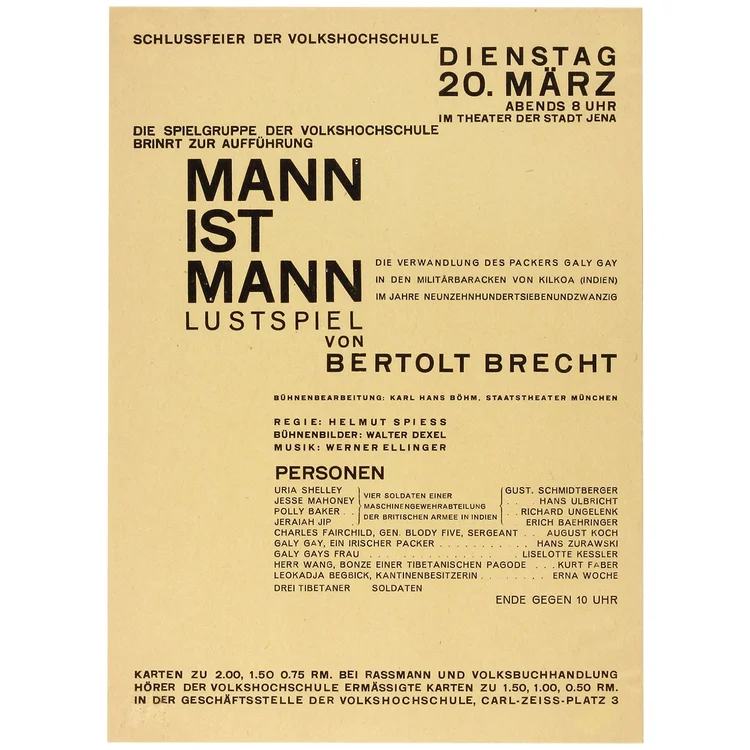
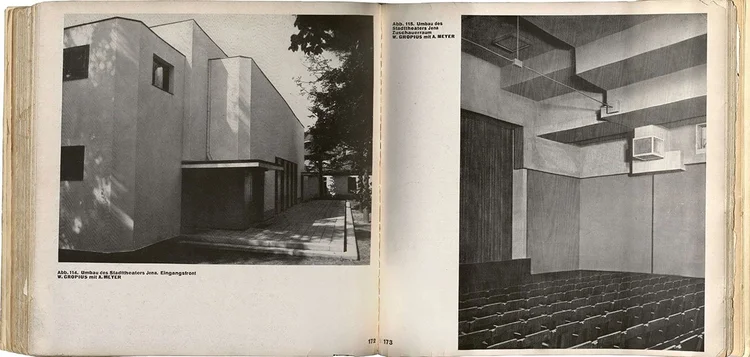
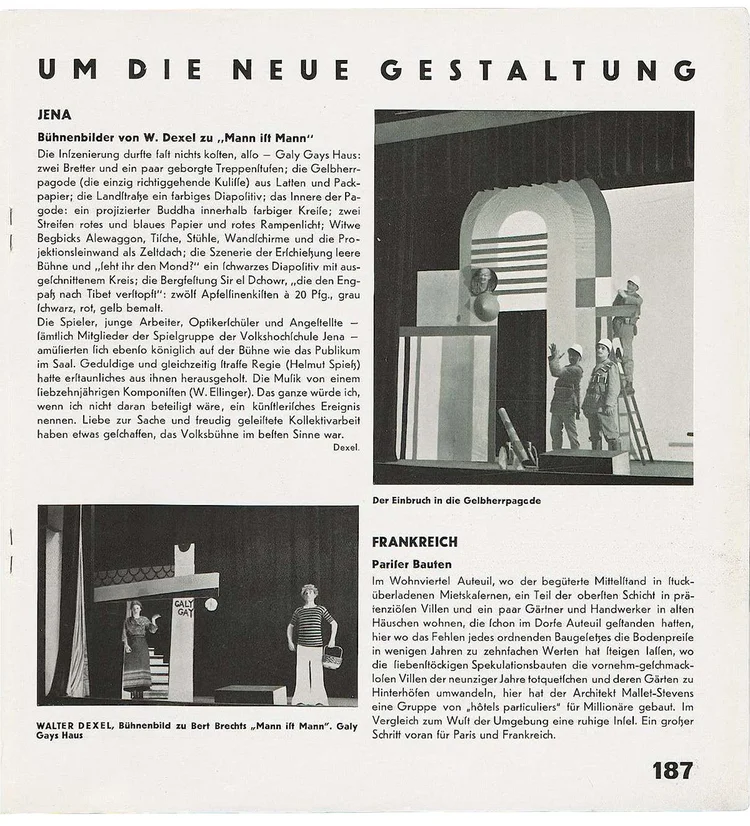
Bertold Brecht’s play Mann ist Mann (Man Equals Man) of 1926 explored the social factors contributing to the transformation of Galy Gay, an Irishman living in a fictional British colony, from an ordinary civilian to an effective soldier. Inspired by Soviet agitprop theater, Mann ist Mann endorsed collectivism and the replaceability of members of the collective. Mann ist Mann premiered in Darmstadt in the fall of 1926 and was staged in a series of provincial German theaters thereafter. In March of 1928, it was presented at the Stadttheater Jena (Jena Municipal Theater), a building recently rennovated by Walter Gropius and Adolf Meyer (see below). The Jena production was directed by Helmut Spiess, with music by Werner Ellinger and sets and promotional material by Walter Dexel. Jena was a vibrant site for the avant-garde during the period when the Bauhaus was located in nearby Weimar (1919–1925) and while Dexel served as director of the Jena Kunstverein (1916–1928). Images of the Jena production of Mann ist Mann were reproduced in the October 1928 issue of Das Neue Frankfurt (also below) with a brief statement by Dexel, who described the cheapest possible production costs for the sets—Galy Gay’s house was comprised of “just two panels and a few borrowed steps”—and the spirit that drove the production. “Even if I hadn’t been involved,” Dexel wrote, “it would have been an artistic event. Love for the cause of collective work created something that was people’s theater (Volksbühne) in the purest sense.”
|