|
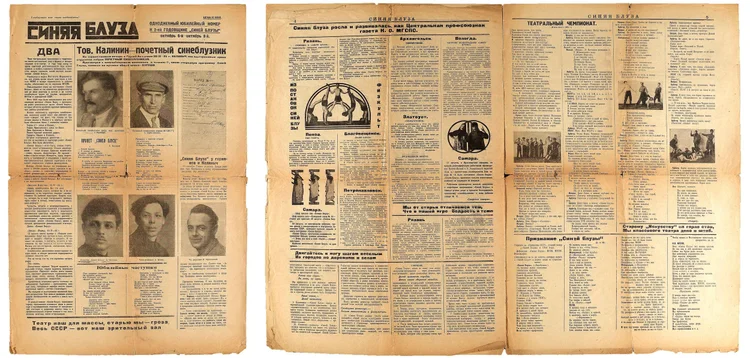
Siniaia bluza (Blue Blouse) was the most vigorous and widespread form of Soviet “agit-prop” (propaganda) theater in the post-revolutionary period. The traveling theater troupe’s name derived from the workers’ clothing worn by the actors during performances; the subject matter concerned current events; and the direct, improvisational style was rooted in experimental theater. The first Blue Blouse troupe was founded in 1923 by the Moscow journalist, Boris Iuzhanin (Yuzhanin; pseudonym for Boris Semenovich Gurevich; 1896–1962). The following year, Iuzhanin launched the biweekly Siniaia bluza journal—see select covers below—to provide scripts (often by well-known writers such as Vladimir Mayakovsky and Sergei Tretyakov), music, librettos, staging, and costume designs for performers who could use these templates verbatim or alter them to suit the given situation. Blue Blouse troupes of twelve to fifteen members traveled the countryside performing in workers’ clubs, factories, cafeterias, and outdoors. A typical program opened with the day’s “headlines,” followed by eight to fifteen short sketches, comprising vocal, gymnastic, and dance numbers. Subject matter dealt with factory life, political events at home and abroad, and the problems of the New Economic Policy. Performances might incorporate popular songs and satires of public figures and make use of exaggerated props such as a top hat to identify a capitalist, or a large red pencil to identify a bureaucrat. The makeshift, mobile, temporary stages did not include backstage areas for intermissions or costume changes. Rather, everything was acted out in front of an audience and success depended on quickly changeable costumes. Always infused with humor and satire, Blue Blouse performances were tremendously popular with audiences and the number of troupes multiplied, eventually operating all over the country. At its height, Blue Blouse was the largest movement of its type in the history of theater, involving more than 100,000 professional and amateur performers. By the early 1930s, however, the group lost favor with the Soviet state. Socialist Realism became official dogma in 1934, and this manner of small, improvisational, grass-roots theater was superseded by large, elaborate, multi-act productions.
|