|
$$PLAIN_TEXT_PREVIEW$$
Günther Wagner / Pelikan: Patron and Collector
|
|
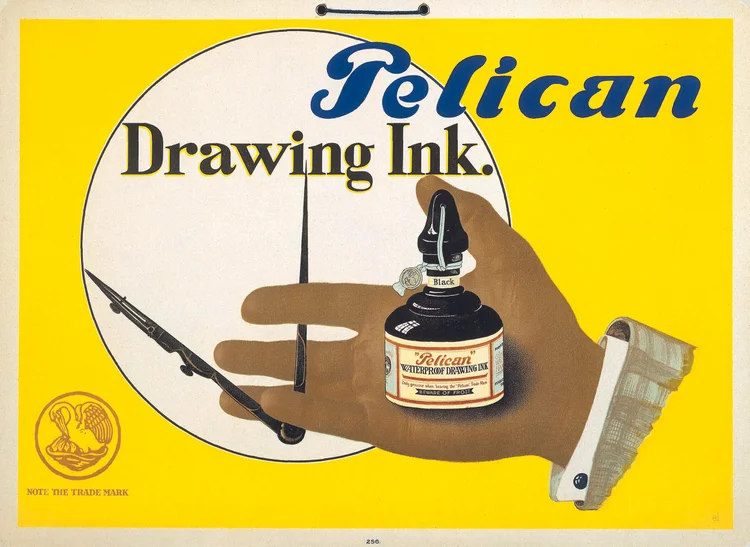
El Lissitzky (Russian, 1890–1941)
Display card: Pelican Drawing Ink, 1925
Lithograph, 12 3/4 x 17 3/8” (32.3 x 18.7 cm)
|
|
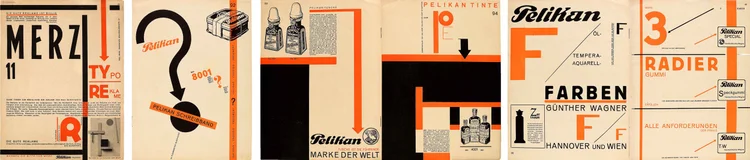
Pelikan was a paper, art, and office supply firm founded in Hannover in 1838. From 1871, under the leadership of the chemist Günther Wagner (1842–1930), and from 1895 under his son-in-law Fritz Beindorff (1860–1944), Pelikan acted as both a patron of artists and as a corporate collector. Among the many early twentieth century posters commissioned by the firm, the bold designs by Paul Hosch and Ludwig Hohlwein (shown below) stand out. In 1924, Pelikan made a daring foray into the avant-garde by commissioning the local Hannover artist Kurt Schwitters and his friend the Russian El Lissitzky to design advertisements (shown above and below). The same year, the firm underwrote the publication of the eleventh number of Schwitters’s journal Merz—the “Pelikan issue.” Money earned from these commissions allowed Lissitzky to reside in Switzerland for tuberculosis treatments and Schwitters to launch his Merzwerbezentrale (Merz advertising agency). Under the direction of Beindorff, a founding member of the Kestner-Gesellschaft, Pelikan collected old masters and modern artworks by artists including Otto Dix, Lyonel Feininger, George Grosz, Wassily Kandinsky, Paul Klee, and Oskar Schlemmer. Much of the fine art collection (and the firm’s archive) was lost in the Second World War. That which remained was supplemented in the postwar period, exhibited in 1963, and largely auctioned in 1985. The drawing by the Hannover-based Neue Sachlichkeit painter Erich Wegner (shown below) was included in the 1985 auction.
|
|
L: Paul Hosch (Swiss, 1886–1975)
Pelikan poster no. 115: Pelikan Tuschen (Pelikan inks), 1909
Lithograph, 23 3/4 x 18 1/2” (60 x 47 cm)
R: Ludwig Hohlwein (German, 1874–1949)
Pelikan poster no. 150: Pelikan Künstler-Farben (Pelikan artist’s paints), c. 1913
Lithograph, 21 7/8 x 16 7/8" (55.75 x 43 cm)
|
|
El Lissitzky (Russian, 1890–1941)
Printed materials for Pelikan, 1924, front to back, left to right:
Multi-page product brochure, 8 7/8 x 6 3/4” (22.5 x 17.1 cm)
Advertisement, 5 7/8 x 4 1/2” (14.9 x 11.4 cm)
Newspaper clipping, 6 1/2 x 5 1/4” (16.5 x 13.3 cm)
Product label, 2 3/4 x 10 3/4” (6.9 x 27.3 cm)
Three boxes of sealing wax, 3 1/2 x 8 3/8 x 1 1/2” (8.8 x 21.2 x 3.8 cm)
and 4 x 9 5/8 x 1” (10.1 x 24.4 x 2.5 cm)
|
|
El Lissitzky (Russian, 1890–1941)
Two sheets of letterhead: Günther Wagner, Hannover and Vienna, 1924
Lithograph on paper 11 1/4 x 8 5/8” (28.5 x 21.9 cm)
Note: The example at right includes a mimeographed letter of May 1926 in French with Günther Wagner’s stamped signature requesting evaluation of Pelikan carbon paper.
|
|
Kurt Schwitters (German, 1887–1948)
Merz, no. 11. Typoreklame, Pelikan-Nummer
(Typographic Advertising, Pelikan Number), 1924
Letterpress, 11 1/2 x 17 1/4” (29.2 x 43.8 cm), open
|
|
Kurt Schwitters’s signet for Pelikan as reproduced in three publications,
left to right:
Jan Tschichold, Typographische Mitteilungen 22, no. 10 (October 1925), p. 193
Jan Tschichold, Die Neue Typographie (1928), p. 113
Kurt Schwitters, “Gestaltende Typographie,” Der Sturm 19, no. 6 (September 1928), p. 269
|
|
Edmund Kesting (German, 1892–1970)
Künstlerfarben (artists’ paints), Günther Wagner, Hannover-Vienna, c. 1925
Gouache and ink on tracing paper, 7 1/8 x 7 1/8” (18 x 18 cm)
|
|
Friedrich Vordemberge-Gildewart (Dutch, born Germany. 1899–1962)
Advertisements for Pelikan on the back covers of Kestner-Gesellschaft Hanover catalogues no. 113 (Walter Gropius, 1931) and no. 118 (Lyonel Feininger, 1932)
Both: letterpress, 7 3/4 x 5 5/8" (20 x 14.3 cm)
|
|
Erich Wegner (German, 1899–1980)
Seemannskneipe (Sailors’ Bar), 1926
Watercolor and pencil on paper, 16 1/8 x 14 1/4" (41 x 36 cm)
Formerly Pelikan-Kunstsammlung, Hannover
(possibly acquired by Pelikan in the postwar period)
|
|
|
|